In modern industrial production, inert gas is required as protective medium
for many working procedures. Nitrogen is widely adopted in various scenarios for
its stable chemical property and low reactivity. Previously, many enterprises
purchased bottled nitrogen or liquid nitrogen. In the long run, expenses keep
accumulating from transportation, tank rental and gasification accessories.
Besides, troubles such as unstable gas supply and difficult tank scheduling
often occur. For this reason, many factories choose to build on-site gas
generation units to satisfy workshop gas demand.
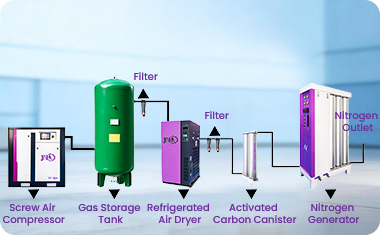
On-site nitrogen production adopts adsorption separation technology. Using
compressed air as feedstock, the system separates oxygen from nitrogen through
pretreatment and adsorption processes to obtain nitrogen that meets process
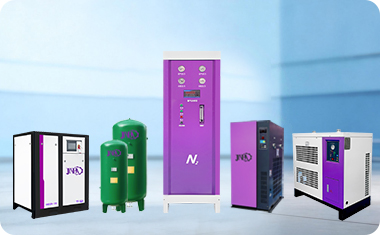
standards. The complete set consists of air supply unit, air purification
assembly, adsorption main unit, pressure stabilizing gas storage module and
monitoring & control parts. With compact structure, it can continuously
produce nitrogen to match the rhythm of continuous workshop production.
During selection, the first step is to sort out gas demand clearly. Core
indicators include nitrogen output, purity and working pressure. Nitrogen
standards vary greatly among industries. Purity requirement is relatively loose
for simple purging and dust removal. In contrast, welding shielding, powder
anti-oxidation, food preservation and electronic packaging usually demand
nitrogen of higher purity. Deviation in parameter estimation at the early stage
may lead to gas failing to meet process requirements and harm product quality.
Excessive design margin will cause the equipment to run under low load for a
long time and waste energy.
Working environment is another factor that cannot be ignored. Ambient
temperature, humidity, dust level and space layout of the workshop affect
equipment performance. In hot and humid conditions, compressed air tends to
carry moisture, increasing the burden of purification components and
accelerating aging of adsorption media. Factories with heavy dust need enhanced
front-end filtration to prevent impurities from entering the main unit.
Sufficient access space and ventilation should be reserved for installation. The
equipment should be placed away from heat sources and corrosive materials to
facilitate maintenance.
Most users pay close attention to operating cost. Compared with purchasing
liquid nitrogen or cylinder gas, on-site gas generation mainly consumes
electricity after initial investment. With properly matched air supply
accessories, it brings sound economic benefits in long-term operation.
Nevertheless, the whole system is more than the main unit. Matching of front air
compressor, drying filters and gas storage tank determines gas stability and
consumable service life. Improper supporting selection may trigger pressure
fluctuation, oil and water carryover, damage adsorption media and raise
maintenance cost.
Regular maintenance is essential to sustain stable operation. Operators
should carry out routine inspection, check pipeline pressure and online meter
readings, and replace filter elements and inspect valve seals on schedule.
Adsorption media have limited service life. Standardized maintenance slows down
performance degradation and extends service cycle. Meanwhile, most control
systems support parameter adjustment. Operators can modify settings according to
changing gas consumption to adapt to variable load in different periods.
Before finalizing the plan, installation conditions of the plant need to be
evaluated, including power supply capacity, pipeline layout and noise control
requirements. Noise reduction accessories are necessary for workshops with
strict noise limits. If gas points are scattered, delivery pipelines shall be
well arranged to minimize pressure loss. Different configurations bring
different performance. Higher configuration is not always better. The priority
is to match actual production requirements.
On-site gas generation offers an alternative gas supply solution for
manufacturers with continuous gas demand. It removes reliance on external
delivery of purchased gas and improves supply autonomy. When planning the
project, enterprises should sort out process parameters, site conditions and
long-term gas demand, compare different schemes, and attach importance to
supporting system matching and regular maintenance. Proper planning and
standardized operation help the gas supply unit work steadily, deliver qualified
inert protective gas for production processes and support long-term
manufacturing.