Large capacity nitrogen generators are core gas supply equipment for
large-scale factory centralized gas supply, chemical deep processing, new energy
material production, pipeline purging, large-scale metallurgy and other
industrial scenarios. They refer to high-volume nitrogen generation systems with
an hourly gas output ranging from tens to hundreds of cubic meters. Compared
with small laboratory and station-type nitrogen production equipment, large
capacity nitrogen generators support 24-hour uninterrupted and stable gas
supply, meeting the massive gas demand of large-scale industrial production. In
the industrial equipment procurement and operation and maintenance system, the
cost of a large-capacity nitrogen generator is not a single purchase price, but
a full-life-cycle comprehensive cost covering pre-procurement, installation and
commissioning, post-operation and maintenance, energy consumption loss, and
consumable replacement. If enterprises only focus on the initial purchase price
during selection and configuration, they will easily fall into operational
dilemmas such as low price with high energy consumption, frequent failures,
substandard production capacity and unstable purity. Therefore, comprehensively
analyzing the cost composition, sorting out price influencing factors and
optimizing long-term investment costs of large capacity nitrogen generators are
key links for industrial enterprises to reduce costs, improve efficiency and
optimize the supporting gas supply system.
The core cost of large capacity nitrogen generators is divided into two
major parts: early-stage fixed asset investment and long-term operating cost.
The upfront procurement cost is the most intuitive core expenditure, mainly
determined by four key factors: equipment production capacity, purity grade,
technical process and system configuration. First, gas production capacity is
the primary indicator affecting the basic pricing of equipment. The relationship
between flow rate and price is not a simple linear proportional growth, but a
sub-linear growth rule. With the same process and purity, doubling the gas flow
rate of the equipment usually increases the procurement cost by 60% to 80%
instead of doubling, showing obvious scale cost advantages. Adopting modular
integrated structure, large-capacity equipment has lower shared cost for core
components. It is more cost-effective in long-term operation than splicing
multiple small-flow equipment, which is the core reason why large-scale
industrial projects prefer integrated large-flow nitrogen generation
systems.
Nitrogen purity grade is a key factor widening the equipment cost gap and
has a significant impact on the overall price. For conventional industrial
protection scenarios requiring nitrogen purity from 99% to 99.9%, the equipment
features simple processes, fewer purification levels and basic component
configuration, resulting in relatively low procurement costs. In contrast,
high-end industries such as new energy, semiconductors and precision chemical
industry that require ultra-high-purity nitrogen of 99.99% to 99.999% need
advanced modules including multi-stage purification, deep deoxygenation and
precision filtration, as well as supporting high-precision detection and voltage
stabilization control systems. Ultra-high-purity and large-flow nitrogen
production equipment requires extremely high precision for molecular sieves,
separation membranes and adsorption towers, leading to a substantial increase in
the procurement and assembly cost of core accessories, and the overall equipment
price rises in a stepwise manner. In addition, output pressure also affects the
final cost. Ordinary atmospheric-pressure output equipment has a low cost, while
high-pressure models for pressurized delivery and long-distance pipeline gas
supply require additional boosters and pressure stabilizing energy storage
systems, further raising investment costs.
Equipment technology and system integration configuration further refine
the cost difference of large capacity nitrogen generators. At present, the
mainstream industrial nitrogen production technologies include PSA pressure
swing adsorption and membrane separation, with different cost structures.
Membrane separation large-flow nitrogen generation equipment features low
upfront procurement cost, simple structure and convenient maintenance, suitable
for general industrial scenarios with low purity requirements and stable
continuous gas production. PSA pressure swing adsorption equipment requires
higher initial investment, but delivers stable nitrogen purity, lower energy
consumption and wider working condition adaptability. It is the mainstream
choice for high-precision large-scale production with better long-term
comprehensive cost performance. Meanwhile, intelligent configuration, automatic
control system, remote monitoring, fault alarm, unattended operation, as well as
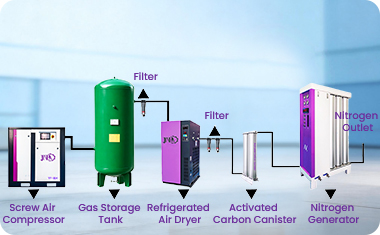
supporting air pre-treatment system, gas storage tank, drying and filtering
components and silent noise reduction devices will form obvious price
stratification according to configuration levels. Although high-end integrated
turnkey equipment has a higher purchase price, it can greatly reduce subsequent
labor and fault maintenance costs.
Compared with one-time procurement investment, the full-life-cycle
operating cost of large capacity nitrogen generators is the core of long-term
enterprise expenditure and the focus of cost control, mainly including energy
consumption, consumable replacement and operation and maintenance inspection
costs. Firstly, power energy consumption is the largest daily expenditure as
large-capacity equipment operates continuously for 24 hours with stable power
consumption of air compressors, adsorption systems and control systems.
High-quality large-scale nitrogen generation equipment adopts an energy-saving
partial-pressure operation mode, which can intelligently adjust production
capacity according to gas load, avoid no-load energy waste, and save more than
30% of energy compared with old equipment, saving huge electricity costs in
long-term operation. Secondly, consumable replacement costs cover core
accessories such as precision filter elements, activated carbon, molecular
sieves and filter cotton. Large-flow equipment bears high airflow load and
frequent filtration, leading to faster consumable loss than small-scale
equipment. Regular replacement is required to ensure gas purity and equipment
efficiency, forming fixed daily expenses.
Operation and maintenance inspection and fault loss costs are also
indispensable. Standard branded large-capacity nitrogen generation systems
feature mature technology, low failure rate and high equipment stability,
requiring only routine inspection and maintenance with low inspection costs. In
contrast, low-cost and low-configured equipment has insufficient component
precision and unreasonable structural design. Long-term high-load operation is
prone to faults such as failed molecular sieves, pipeline air leakage, unstable
pressure and fluctuating purity. It not only requires frequent accessory
replacement and maintenance, but also may cause production line shutdowns due to
equipment failure, resulting in indirect production loss. In addition, hidden
costs such as equipment installation and commissioning, site adaptation,
pipeline laying and personnel training should be included in the overall cost
accounting. Integrated equipment with convenient installation and strong
adaptability can effectively reduce hidden investment.
In conclusion, the core logic of controlling the overall cost of large
capacity nitrogen generators is to abandon the simple price-comparison
procurement mindset and select models based on full-life-cycle cost performance.
Enterprises shall match appropriate processes and configurations according to
actual working conditions such as gas flow demand, purity, pressure and
operating duration, avoiding excessive configuration waste or insufficient
configuration. Prioritizing energy-saving modular large-capacity nitrogen
generation equipment with reasonable upfront investment and refined long-term
operation and maintenance can not only ensure stable gas supply for large-scale
production, but also minimize energy consumption, consumable loss and fault
costs. In modern large-scale industrial production, the reasonable selection and
cost control of large capacity nitrogen generators are not only basic equipment
procurement work, but also important measures for enterprises to optimize
production costs, improve production stability and enhance market
competitiveness.