When selecting and purchasing a Local Nitrogen Generator, most buyers tend
to focus on quoted purchase price, while easily overlooking power consumption, a
core variable that determines long‑term operating expenditure. The purchase
price is one‑time capital investment, whereas electricity cost persists
throughout the 8‑10‑year service life. Under many working conditions, cumulative
power expenses can even exceed the original equipment cost. For local nitrogen
generators with identical nominal flow rate and purity, significant price gaps
exist in the market, largely stemming from different power‑efficiency design
standards. From the perspective of power consumption, this article analyzes the
energy‑consumption composition, key design factors affecting power draw,
trade‑offs between power consumption and purchase price, and approaches to cut
overall operating cost via low‑power design. It delivers rational reference for
end‑users in industrial manufacturing, lithium‑ion battery, chemical, laser
processing and other sectors.
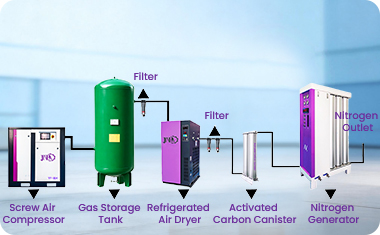
The overall power consumption of a complete local nitrogen generator system
does not merely come from the PSA nitrogen host itself. It is a combined energy
consumption covering air compressor, pretreatment unit, PSA adsorption host and
post‑purification modules. The PSA main unit mainly consumes minor power for
solenoid valves, PLC and sensors. The vast majority of electricity is consumed
by compressed‑air production, and the load condition of air compressor dominates
overall system power draw. Compressed air flows through refrigerated dryer and
multi‑stage filters before entering adsorption towers for nitrogen‑oxygen
separation by carbon molecular sieve. Higher nitrogen purity demands larger
compressed‑air consumption, which raises specific power consumption per unit
nitrogen output. For instance, power consumption remains relatively low at 99.5%
purity, while upgrading to 99.999% ultra‑high purity leads to higher
air‑to‑nitrogen ratio and notable power‑consumption growth under same nitrogen
flow rate. Many purchasers only compare host prices without calculating total
system energy consumption. Low‑priced units usually feature high air‑to‑nitrogen
ratio, resulting in high electricity bills during operation. They seem cheap to
buy yet bring higher total cost of ownership over long‑term operation.
Molecular sieve material and filling technology set the lower limit of
system power consumption. As the functional medium for nitrogen‑oxygen
separation, carbon molecular sieve’s adsorption capacity and screening
selectivity directly govern compressed‑air consumption. High‑performance
molecular sieve delivers superior oxygen adsorption capacity. For given nitrogen
output, it reduces required compressed‑air volume and air‑compressor load to
save energy. Low‑grade molecular sieve shows poor adsorption efficiency,
requiring higher compressed‑air flow to reach target purity and increasing
overall power consumption. Besides raw material quality, tower filling process
also influences energy performance. Loose filling causes gas channeling and
biased flow inside adsorption vessels. Part of molecular sieve cannot fully
participate in adsorption reaction. To maintain stable gas output, the system
has to increase inlet air flow to compensate efficiency loss, generating
unnecessary power waste. Some low‑cost products adopt ordinary molecular sieve
and simplify compaction process to cut hardware cost. Though selling price is
reduced, specific power consumption per Nm³ nitrogen rises remarkably. For
continuous mass‑production scenarios, electricity cost gap keeps expanding year
by year. This constitutes one major underlying reason for price divergence among
local nitrogen generators with same nominal parameters.
Control logic and dynamic load‑adjustment design determine real‑world power
performance under variable working conditions. Industrial nitrogen demand is
seldom constant. Production shift and batch processing bring fluctuating
nitrogen flow, including full‑load operation, partial‑load status and
intermittent usage. Conventional basic local nitrogen generators adopt
fixed‑timing control. Regardless of actual gas demand, adsorption towers keep
cycling at fixed intervals, consuming considerable compressed air at
low‑gas‑demand phases and causing idle energy waste. High‑efficiency units are
equipped with intelligent oxygen‑feedback variable‑frequency control system. It
dynamically adjusts adsorption, pressure‑equalization and regeneration cycles
according to real‑time downstream nitrogen consumption. The system runs at full
capacity during peak gas demand, extends timing cycles and cuts compressed‑air
consumption at low‑load conditions, and enters low‑power standby mode when idle
to eliminate no‑load losses. Compared with fixed‑sequence machines, models with
intelligent load regulation achieve 15%‑25% energy saving under
fluctuating‑demand scenarios. Such intelligent control increases upfront
purchase cost, yet for factories with intermittent production and variable gas
consumption, saved electricity expenses can quickly offset price premium and
shorten payback period.
Pretreatment and gas‑circuit structural design indirectly affect system
power‑consumption level. Pretreatment assemblies including refrigerated dryers
and precision filters do not directly participate in gas separation. However,
failed filtration allows moisture, oil and contaminants to poison molecular
sieve media. Once adsorbent performance degrades, higher inlet pressure and air
flow must be supplied to retain target purity, which passively pushes up system
power consumption. Improper pipeline layout and low‑precision valves trigger
continuous pressure drop and leakage. Air compressors have to raise working
pressure to compensate pressure loss; power consumption rises roughly by 1%‑2%
per 0.14 MPa pressure increase. Some low‑cost units simplify pretreatment
configuration and use ordinary pneumatic valves plus rudimentary piping. They
can produce qualified nitrogen in short term, yet molecular sieve aging
accelerates. System power draw keeps climbing after two to three years of
operation, together with higher maintenance frequency and accumulated hidden
costs. Premium solutions adopt low‑resistance gas routing, high‑accuracy valves
and complete four‑stage pretreatment. Higher initial hardware cost is offset by
sustained low‑power operation and delayed adsorbent degradation.
Balance purchase price against power consumption to evaluate
total‑life‑cycle cost. When comparing quotations of Local Nitrogen Generator,
buyers should not merely focus on bare‑machine price. Power‑consumption
indicators shall be included in evaluation criteria. Total‑life‑cycle cost can
be calculated as: total equipment purchase cost + cumulative electricity expense
over service life + annual maintenance cost. For example, two generators with
identical nominal flow and purity: Unit A offers lower purchase price yet higher
specific power consumption; Unit B comes with higher quotation but excellent
air‑to‑nitrogen ratio and intelligent load adjustment. Under 8000 annual
operating hours, electricity saved by Unit B can cover its price premium within
several years and deliver continuous cost benefits afterwards. In contrast, pure
low‑price procurement reduces initial outlay, yet cumulative high electricity
bills erode corporate profit. Nevertheless, ultra‑high‑efficiency configuration
is not always mandatory. If equipment runs only for limited hours per year with
frequent idle periods, controlling purchase price is also reasonable. The key of
equipment selection is to match actual operating hours, purity requirements and
local electricity tariff, treating power‑consumption metrics as critical
benchmark for price comparison.
In short, price differences among local nitrogen generators reflect not
only material and workmanship gaps, but more importantly, divergence in
power‑efficiency design. Purchase price represents one‑time entry barrier, while
power consumption creates long‑term operational burden. By understanding
energy‑consumption sources and influencing factors, and assessing
total‑life‑cycle cost, enterprises can avoid the selection trap of “low‑price
yet high‑energy‑cost”, and select well‑matched on‑site nitrogen generation
solutions for real‑world cost reduction and efficiency improvement.