Within complete high-purity nitrogen generation gas supply systems,
nitrogen compressors are responsible for gas pressurization and pipeline
transportation. They are widely applied in semiconductor packaging, lithium
battery manufacturing, metal heat treatment, laser processing and other fields.
A long service life nitrogen compressor adopts robust structural design, premium
material selection and well-engineered lubrication & sealing schemes to
operate stably under continuous working conditions. It reduces the frequency of
shutdown overhauls and cuts the full-lifecycle cost of the whole gas supply
system. Premature failures of nitrogen generation equipment in many factories
often stem from component wear of the boosting unit, impurity ingress or cooling
failure rather than defects of the main unit itself. Therefore, boosting
equipment with long service life is a critical component that cannot be
overlooked when planning the whole nitrogen gas supply system.
Nitrogen compressors are mainly divided into screw type and reciprocating
piston type according to their structures, and the two types follow different
technical routes to achieve long service life. Screw models feature simple
structures with fewer moving parts and low vibration, suitable for medium &
low pressure, large-flow continuous boosting scenarios. Rotor material and
precision machining accuracy directly determine the total service life of the
whole machine. Reciprocating piston compressors fit high-pressure working
conditions. With high-strength cylinder blocks, valve assemblies and packing
seals, they are widely adopted for high-pressure nitrogen boosting. To extend
service life, both types prioritize material optimization: frames are generally
made of ductile iron, crankshafts of forged steel, piston rings and packing
seals of wear-resistant composite materials, and gas valves of fatigue-resistant
stainless steel. These choices reduce fatigue wear caused by alternating
pressure. Oil-free models adopt an extended distance piece to physically
separate the lubricated crankcase from the compression chamber, preventing
lubricating oil from entering nitrogen pipelines and protecting seals from oil
contamination to extend the service life of sealing assemblies.
Core factors determining equipment service life include gas cleanliness,
cooling systems, lubrication schemes, load design and automatic protection
logic. If nitrogen entering the compressor contains dust, moisture or trace oil,
it will continuously abrade piston rings, valve plates and bearings and
accelerate component aging. Therefore, long-service-life models are usually
equipped with multi-stage filters and gas dryers at the front end to pretreat
inlet gas and reduce ingress of solid particles and liquid impurities into
compression chambers. Cooling systems are equally critical; compression
generates substantial heat, and sustained high temperature causes seal aging and
lubricant degradation. Water-cooled units are fitted with independent heat
exchangers, while air-cooled versions optimize air ducts and heat dissipation
structures to stabilize body temperature within a proper range and avoid
accelerated component failure induced by high temperature. In terms of load,
long-life compressors usually adopt low specific pressure design to reduce the
force per unit area on wearing parts such as bearings, pistons and packing and
mitigate fatigue loss. The control system integrates multi-dimensional sensors
for pressure, temperature, vibration and oil pressure. In case of
over-temperature, over-pressure, abnormal vibration or low oil level, it
triggers alarms or automatic shutdown protection to prevent irreversible damage
caused by continuous operation under harsh working conditions.
Working conditions in different industries impose distinct requirements on
long service life nitrogen compressors. Semiconductor and lithium battery
production lines demand high gas purity and mostly select oil-free boosting
models to avoid oil contamination of high-purity protective gas. High-pressure
gas supply loops for metal heat treatment and laser cutting require stable
continuous high-pressure output and prefer reciprocating boosting equipment. For
routine nitrogen transportation in small and medium factories, screw compressors
can be adopted for medium-low pressure and large-flow conditions. Equipment
specifications range from small skid-mounted boosting units to large stationary
sets, compatible with nitrogen sources from PSA nitrogen generators, membrane
separation and cryogenic air separation. The equipment can be fitted with local
control modules or connected to factory DCS systems. Some models support remote
monitoring to collect real-time operating data such as vibration, temperature
and pressure for fault early warning and predictive maintenance. It enables
prediction of wear trends of seals and valve plates so maintenance can be
arranged before complete component failure and unexpected shutdowns avoided.
During project selection, buyers should not only focus on rated flow and
output pressure, but comprehensively evaluate long-term reliability. First,
verify material certificates of core components and third-party performance test
documents, and assess the designed service life of wearing parts instead of
merely comparing main unit quotations. Second, evaluate the front-end inlet gas
pretreatment solution. Inlet gas cleanliness forms the foundation of extended
service life; even high-quality main units will wear rapidly without adequate
front filtration and drying. Redundant design of cooling systems also needs
careful assessment. Insufficient heat dissipation under high ambient temperature
will significantly shorten the service cycle of seals and lubricants. It is also
necessary to evaluate manufacturers’ engineering service capacity, including
installation & commissioning, spare parts supply and overhaul technical
support. Skid-mounted boosting units are fully assembled, piped and tested
before delivery, reducing on-site construction workload and long-term risks
brought by improper field assembly. During procurement, assess the spare parts
supply chain. Stable supply of consumables such as piston rings, packing, gas
valves and bearings directly affects later operation and maintenance
efficiency.
After commissioning, standardized periodic maintenance is essential to
realize the designed service life of the equipment. Routine maintenance includes
inspection, consumable replacement, instrument calibration and condition
monitoring. Daily inspections focus on monitoring body temperature, vibration,
inlet & outlet pressure, lubricant level and quality, and recording trends
of operating parameters. Replace filters, lubricants and sealing components
regularly according to manufacturer specifications. For oil-lubricated models,
take oil samples on schedule for testing; replace lubricant promptly once
excessive metal particles or oxidative degradation are detected. Oil-free models
focus on inspecting wear of packing and piston rings and measuring gas leakage.
Cooling systems require regular cleaning of heat exchangers or cooling fins to
prevent heat efficiency reduction caused by scaling and dust accumulation.
Online monitoring instruments need regular calibration to guarantee accurate
collection of temperature, pressure and vibration data and avoid false alarms or
failure to trigger alarms. Operation and maintenance staff should be familiar
with equipment protection logic and identify early abnormal signals instead of
waiting for severe component damage before maintenance. It must be clarified
that automatic protection systems serve only as safety backups and cannot
replace manual inspections and periodic maintenance.
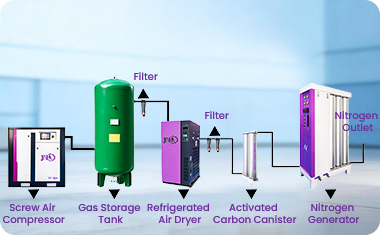
A long service life nitrogen compressor is one part of the complete
nitrogen gas supply system and must work in coordination with nitrogen
generators, gas storage tanks, pressure stabilizing buffer tanks and pipeline
filters. Pipeline design, buffer vessel selection and pulsation suppression
schemes of the whole system all affect the stability of booster operation.
Pressure pulsation introduces extra alternating loads and aggravates fatigue of
gas valves, pipelines and machine bodies. Under high-pressure conditions,
pulsation suppression design is a non-negligible factor for extending service
life. As industrial manufacturing develops toward long-cycle and low-maintenance
operation, compressor manufacturers keep optimizing materials, sealing
structures and intelligent monitoring solutions to further reduce wear rates. In
the project planning phase, enterprises should select models comprehensively
based on gas source purity, pressure, flow rate and environmental conditions,
and design front-end pretreatment and back-end pressure stabilization systems.
Proper selection paired with standardized predictive maintenance can maximize
the designed service life of equipment, reduce overhaul frequency, mitigate
production line shutdown risks, lower long-term operating costs of the whole
nitrogen gas supply system and guarantee stable and continuous industrial
production.