Application Points and Process Adaptation of On-site Nitrogen Supply in
Wine Bottling Lines
Wine is a beverage sensitive to oxygen. Trace oxygen remaining in the
bottling stage will trigger oxidation reactions during storage and alter the
color, aroma and taste profile of the wine. Beyond the dissolved oxygen level of
the wine itself, air remaining in the bottle headspace also exchanges substances
continuously with the liquid. For this reason, introducing stable inert gas
protection into bottling lines has become a technical topic of interest for many
wineries and contract bottling plants. Among the available options, a nitrogen
generator for wine bottling is frequently adopted because it delivers a
continuous supply and is easy to manage centrally.
From the process standpoint, nitrogen intervenes at several steps before
and after filling. Before filling, empty bottles are purged to remove dust and
residual air. During filling, a nitrogen layer is formed in the headspace by
drip dosing or nozzles, displacing oxygen and narrowing the oxidation window
before closure. After closure, the headspace nitrogen layer slows the diffusion
of oxygen into the wine. Nitrogen blanketing of storage tanks, transfer tanks
and conveying lines likewise relies on nitrogen to maintain slight positive
pressure and keep the wine away from direct contact with air.
Compared with liquid nitrogen tankers and purchased cylinders, on-site
generation avoids continuous transport and turnover. Gas can be produced as the
line requires, which suits bottling halls with high consumption and continuous
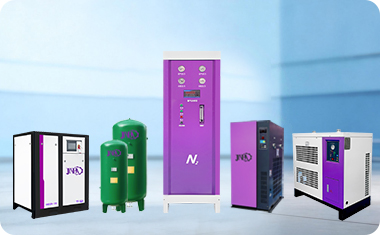
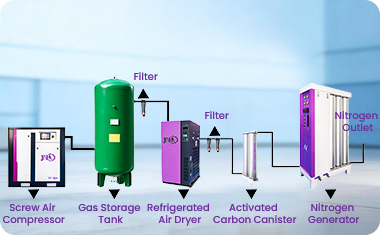
shifts. The trade-off is the upfront installation of a package comprising
compressed air equipment, refrigerated dryers, filters and the generation unit
itself, together with floor space for a machine room. For seasonal lines with
modest demand, purchased liquid nitrogen still offers greater flexibility. The
choice should be judged against annual output, filling speed and site
conditions.
Food safety requirements deserve separate discussion. Nitrogen that
contacts the wine or the bottle mouth should be controlled according to food
additive standards, with attention to purity, dew point, oil content, carbon
monoxide, particulate matter and odor. Test records and compliance documents
should be retained. If the compressed air at the source contains oil, it will
travel downstream with the gas stream and affect the flavor of the wine, so
oil-free compression and multi-stage filtration are common configurations. Some
producing regions also require declarations on materials, coatings and
lubricants.
Equipment selection should not rely on rated output alone. Gas demand on a
bottling line fluctuates markedly: dosing actions are concentrated with high
instantaneous flow, while purging is distributed along the whole line. Peak and
average flow should be calculated separately, and buffer tanks plus pressure
regulators of sufficient volume should be installed to prevent pressure drops
that leave dosing short. Purity and flow are interrelated; higher purity reduces
the usable flow, so a margin should be reserved according to actual needs. Dew
point directly affects headspace dryness and deserves particular attention in
humid workshops.
The material and routing of nitrogen piping also influence results.
Stainless steel or food-grade tubing is preferable, with few bends and dead ends
where gas may stagnate. The position, angle and flow of dosing nozzles should be
established through trial filling. Excessive dosing lowers residual oxygen but
raises gas consumption and may cause abnormal headspace pressure or cork
popping. Once parameters are fixed, they should be written into work
instructions and rechecked whenever the bottle format changes.
Verification and monitoring after commissioning form an indispensable part
of the closed loop. Dissolved oxygen checkpoints can be set on the line,
sampling both headspace residual oxygen and dissolved oxygen in the wine to
establish baseline data and track trends. Nitrogen purity is best monitored
continuously with an online analyzer, cross-checked by periodic manual sampling,
so that adsorbent degradation or filter damage is not overlooked. The data
should be incorporated into food safety management documents as traceable
records for internal audits and external inspections.
Routine maintenance focuses on both gas purification and the generation
unit. Filter elements, automatic drain valves, refrigerated dryers and
adsorption towers are key inspection points. Degradation of carbon molecular
sieve shows directly in purity and flow readings, so operating hours should be
logged and replacement scheduled. Machine room ventilation, ambient temperature
and intake air quality all affect stability, and these items are best fixed in
the checklist.
In terms of operating cost structure, on-site generation spending comes
mainly from electricity, compressed air preparation and consumable replacement,
with per-bottle cost falling as output rises. Purchased liquid nitrogen is
priced by volume, so unit price weighs more heavily when consumption is low.
Neither model is inherently superior; the decisive factor is how well it matches
the load curve of the line.
Overall, inert protection in bottling is a systematic matter in which
nitrogen is only one link. Actual results depend on the coordination of gas
quality, piping design, dosing parameters and closure process. Only by
connecting equipment capability, process parameters and quality verification
into a closed loop can wine stability be maintained while operating costs stay
under control.