Air Supply Quality Control and Configuration Points for Nitrogen Systems
Equipped with Drying Units
The output quality of a nitrogen production system is largely determined by
the condition of the compressed air entering the main unit. Ambient air, once
pressurized by the compressor, rises in temperature and approaches saturation in
relative humidity, and the subsequent cooling process releases a large amount of
condensate. If this moisture reaches the nitrogen unit untreated, the adsorbent
becomes wetted and loses separation capability, while piping and valves suffer
corrosion, scaling and impaired action. The drying unit therefore serves as a
front-end safeguard in the overall configuration, and its selection and
operating condition directly affect output purity, dew point and equipment
service life.
The impact of moisture on nitrogen processes is manifold. Carbon molecular
sieve and zeolite molecular sieve achieve oxygen-nitrogen separation through
their micropore structure. Once moisture is adsorbed, the micropores are
occupied, output and purity decline together, and such degradation is often
irreversible. In cryogenic processes, residual water vapor freezes inside heat
exchangers, causing blockage and rising pressure differential. On the piping
side, condensate accumulates, encourages microbial growth and may even cause
freezing damage in winter. For industries such as food and pharmaceuticals with
explicit gas quality standards, dew point itself is a delivery indicator that
must be controlled.
Common drying methods each have their applicable range. Refrigerated dryers
use refrigerant to lower compressed air temperature so that water vapor
condenses and separates, with pressure dew points typically between two and ten
degrees Celsius. They are simple in structure and relatively low in energy use,
suitable for general industrial duty where dew point requirements are moderate.
Heatless adsorption dryers regenerate desiccant by depressurizing a portion of
the product gas, reaching pressure dew points of minus forty degrees Celsius or
lower, at the cost of a certain proportion of purge gas. Heater-assisted
regeneration types introduce limited heating during regeneration to reduce purge
consumption, acting as a compromise. In hot and humid regions, or where the
compressor room runs warm, a combination of refrigerated and adsorption drying
in series is common: the former carries the main dewatering load, the latter
secures the final dew point.
Several easily overlooked parameters matter during selection. Rated flow of
a dryer is usually calibrated at specific inlet temperature, pressure and dew
point conditions; when actual conditions deviate, correction factors must be
applied, otherwise capacity proves insufficient. Purge consumption of adsorption
dryers generally falls between fifteen and twenty percent; since this gas does
not reach downstream stages, it must be counted when sizing the intake of the
nitrogen unit. The pressure drop across the dryer also affects inlet pressure at
the main unit, and excessive drop directly reduces production efficiency.
Oil and dust removal cannot be omitted either. Oil mist in compressed air
contaminates desiccant, reduces its regeneration capability and may penetrate
into the molecular sieve bed, causing permanent damage. The usual practice is to
install cyclone separation and coarse filtration at the compressor outlet, then
place precision and activated carbon filters upstream and downstream of the
dryer to intercept contaminants stage by stage. Filtration grades can be set
according to the classification of solid particles, water and oil content in
compressed air quality standards.
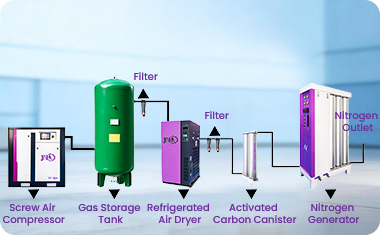
【Materials】A typical configuration involves the following main components:
screw or scroll air compressor with aftercooler, air receiver, cyclone water
separator, refrigerated dryer, heatless or heater-assisted adsorption dryer,
first and second stage precision filters, activated carbon oil removal filter,
automatic and manual drain valves, dew point meter and pressure gauges,
stainless steel or aluminum piping and fittings, nitrogen generation unit with
adsorption towers, nitrogen buffer tank, flow meter and oxygen analyzer,
silencer and safety valve. For piping material, stainless steel performs well in
corrosion resistance and cleanliness, aluminum alloy piping is easy to install,
and galvanized pipe requires attention to internal rust risk.
Operating problems most often relate to drainage and filter elements.
Failure of automatic drain valves allows condensate to accumulate and flow back
downstream, a common cause of premature adsorbent failure; filter elements kept
in service beyond their interval raise pressure differential and reduce oil
removal efficiency. If regeneration valves, heating elements or switching
sequences of an adsorption dryer drift, dew point rises slowly and is hard to
detect by touch at the outlet, so an online dew point meter or periodic sampling
is needed.
Daily management should fix several inspection items: compressor outlet
temperature and drainage, pressure differential across each filter stage, dryer
switching action and regeneration temperature, receiver blowdown, dew point
trend and pressure differential across the nitrogen unit. Recording these data
allows anomalies to be detected early in the drift phase, preventing main unit
failures caused by degraded air supply. Replacement intervals for desiccant and
filter elements should be based on actual operating hours and dew point behavior
rather than on catalog intervals alone.
Overall, the drying unit is not an accessory of the nitrogen system but a
key link determining air supply quality. By incorporating intake conditions, dew
point requirements, purge consumption and pressure drop losses into the design
calculation, and pairing them with proper filtration and routine inspection, the
system can maintain stable purity output and reasonable maintenance spending
over long-term operation.