In chemical production processes, inert gas is required in many reaction
units, material storage and product packaging sections to isolate oxygen,
restrain oxidation, spontaneous combustion and side reactions, so as to
guarantee process safety and product quality. Gas consumption conditions in
chemical plants are complicated. Some workshops demand continuous gas supply
together with strict standards for nitrogen purity, supply stability and safety
protection. Traditional gas supply by purchased cylinders or liquid nitrogen
tanks faces strict transportation control, limited refilling cycles and
relatively high risks of high-pressure storage. PSA nitrogen generators,
featuring on-site gas production and long-term continuous operation, have
gradually been adopted in chemical plant areas.
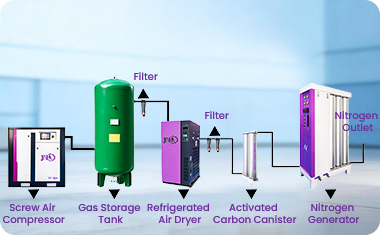
PSA nitrogen generation uses compressed air as raw material and realizes
nitrogen-oxygen separation by virtue of the selective adsorption property of
carbon molecular sieves. Clean air after oil removal, dust removal and drying
pretreatment flows into the adsorption tower. Under pressurized conditions,
oxygen molecules are adsorbed by molecular sieves while nitrogen is separated
and delivered. The other tower carries out pressure relief and desorption
simultaneously to release oxygen and regenerate molecular sieves. Dual towers
work alternately in cycles to achieve uninterrupted gas production. A complete
system mainly consists of an air pretreatment module, adsorption tower assembly,
program-controlled valves, buffer gas storage unit, online monitoring and
control system. Pretreatment acts as the primary protection for the service life
of adsorbents. Chemical environments usually contain more dust and corrosive
gas. Multi-stage filtration and drying equipment can reduce impurities and
moisture in inlet air, prevent molecular sieve poisoning and pulverization, and
sustain stable gas production capacity of the system.
When selecting equipment for chemical plants, multi-dimensional evaluation
should be carried out combined with process characteristics and plant
specifications. First, clarify gas flow demand of each consumption point,
distinguish normal flow and instantaneous peak flow, and reserve reasonable
allowance to avoid long-term full-load operation. Nitrogen purity must match
corresponding processes. There is a clear gap between the requirements for
simple material protection and fine synthesis reactions. Some reaction sections
also set clear limits for residual oxygen and dew point in nitrogen. Besides,
output pressure, explosion-proof grade, corrosion resistance, noise, energy
consumption and footprint should all be considered in scheme assessment. Most
chemical zones are divided into explosion-proof areas, so explosion-proof
certificates and anti-corrosion treatment for electrical components and valves
must comply with plant safety codes. If the plant is equipped with a central
clean compressed air pipeline network, split configurations without built-in air
compressors can be selected to reduce on-site equipment stacking.
Supporting service systems are especially critical for chemical scenarios.
Shutdown of chemical facilities brings high costs, and unexpected gas cut-off
may trigger cascading safety hazards. For sections requiring non-stop gas
supply, backup units or emergency gas sources can be deployed to build redundant
gas supply schemes. During preliminary communication, it is necessary to verify
the supply channels and delivery cycles of consumables such as filter elements,
seals, program-controlled valves and carbon molecular sieves, as well as
suppliers’ capacity for remote commissioning, fault diagnosis and on-site
maintenance response. Many chemical projects require equipment with complete
data acquisition and alarm output functions for connection with the plant DCS
system, to realize unified monitoring and recording of gas source operation.
Warnings will be sent promptly once purity or pressure goes abnormal for rapid
handling by process operators.
As the chemical industry raises standards for safety management and energy
conservation, the design of such nitrogen generators keeps being optimized.
R&D focuses on lowering gas loss, improving adsorption efficiency and
optimizing valve timing control to cut nitrogen waste during pressure
equalization. The control system can adjust operating parameters automatically
according to gas load, adapting to low-load conditions during low consumption
periods to save energy. Apart from standard models, solution providers can
adjust pipeline materials, connector types and control logic within a reasonable
scope to fit customized on-site conditions such as corrosive environments and
multi-branch distributed gas supply.
After equipment arrives on site, installation, pipeline pressure test, leak
detection and joint commissioning shall be implemented strictly in line with
chemical construction specifications. Before commissioning, system purging and
parameter calibration need to be finished. Process pipelines can only be
connected after purity, pressure and alarm logic all meet standards.
Standardized operation logs should be kept for daily maintenance. Filter
consumables are replaced periodically, valve sealing and pipeline corrosion are
inspected regularly, and online oxygen monitoring meters are calibrated. Carbon
molecular sieves are consumable adsorption media whose adsorption performance
declines after long-time running. Refilling or replacement shall be arranged
based on regular test results. Standardized maintenance stabilizes gas quality
and helps avoid process risks caused by equipment anomalies.
Compared with gas supply via cylinders or outsourced liquid nitrogen,
on-site PSA nitrogen generation eliminates frequent transportation of hazardous
gas containers, relieves management burdens of high-pressure storage tanks and
enables self-controlled gas supply. Long-term operating costs are easier to
calculate. However, this solution is not suitable for all cases. For scattered
consumption points with extremely low usage frequency, overall cost and benefit
should be assessed comprehensively before deciding the gas supply mode.
During gas source scheme evaluation for chemical projects, responsible
personnel may focus on measured equipment performance data, application
references in similar chemical projects and certification documents related to
material and explosion protection. Partners capable of providing complete test
reports and operation & maintenance procedures are preferred, to ensure the
whole nitrogen generation system satisfies stringent safety and process
requirements of chemical plants and delivers stable inert shielding gas for each
workshop section.