As gas application scenarios become increasingly diversified, on-site gas
generation solutions are gradually reshaping traditional gas supply modes. In
the past, many laboratories, small processing plants, food workshops and
electronic processing stations relied heavily on cylinder nitrogen or liquid
nitrogen procurement. This required logistics coordination, dedicated storage
space, and came with risks such as interrupted gas supply, unstable pressure and
complicated management procedures. Compact nitrogen production equipment, with
small footprint, stable output and flexible installation, has become a
well-accepted gas supply option for applications requiring low nitrogen flow. CE
marking serves as a compliance prerequisite for circulation within the European
Economic Area. It indicates that the equipment has undergone relevant
assessments and meets corresponding EU standards in electrical safety,
mechanical protection, pressure component specifications and environmental
requirements, offering compliance references for overseas buyers and
operators.
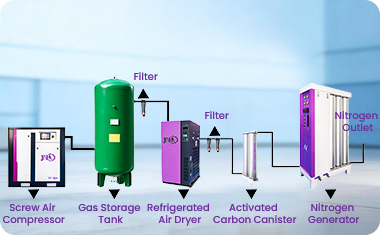
Most equipment of this type adopts pressure swing adsorption technology,
using ambient air as raw material. Nitrogen and oxygen are separated by taking
advantage of the different adsorption rates of carbon molecular sieve to oxygen
and nitrogen molecules in air. Compressed air goes through multi-stage
filtration and drying pretreatment to remove moisture, oil, solid particles and
other impurities before entering adsorption towers. Under pressurized
conditions, molecular sieve preferentially adsorbs oxygen while nitrogen remains
in the gas phase and is delivered after pressure stabilization and buffering.
Once the molecular sieve approaches adsorption saturation, the system
automatically releases pressure. Adsorbed oxygen is desorbed and discharged so
that the molecular sieve can be regenerated. Usually two adsorption towers work
alternately to realize continuous nitrogen output. No low-temperature
refrigeration unit is required, and the equipment can operate at ambient
temperature, reaching preset working conditions shortly after startup. Besides
pressure swing adsorption models, membrane separation versions feature simpler
structures with fewer valve parts and relatively relaxed maintenance schedules,
suitable for applications with moderate purity requirements and low maintenance
expectations.
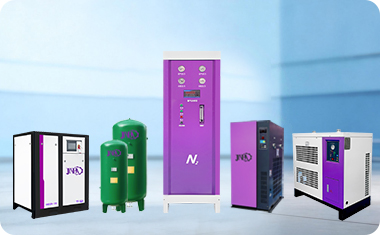
The equipment is optimized for compact layout. Many units are skid-mounted,
integrating air compressors, filter assemblies and buffer tanks on one frame.
They occupy limited space and can be placed in corners of laboratories or idle
stations in workshops without large dedicated machine rooms. Most units are
equipped with programmable controllers together with pressure and flow
monitoring modules. Operating parameters are displayed clearly with intuitive
operation logic. After basic configuration, the equipment can run automatically
with minimal manual attendance. Nitrogen purity can be adjusted within a certain
range according to practical needs. High purity is preferred for chromatographic
testing and mass spectrometry analysis. Medium purity settings are acceptable
for modified atmosphere packaging, tank blanketing and auxiliary laser
processing, balancing gas performance and energy consumption.
The equipment serves a wide range of industries. In analytical
laboratories, it supplies steady gas for GC, LC-MS and other analytical
instruments, avoiding experiment interruption during cylinder replacement and
reducing interference on test data caused by pressure fluctuation. In food
processing, nitrogen displaces oxygen inside packages for modified atmosphere
packaging. This slows lipid oxidation and inhibits microbial activity, helping
preserve flavor and extend shelf life. Small batch food producers, bakeries and
nut processing workshops can select suitable models accordingly. In electronic
manufacturing, inert gas atmosphere is required for some soldering and
encapsulation processes to reduce metal oxidation under high temperature and
improve finished product quality. It is also widely used for chemical sample
reactions, new material research, inert protection of small storage tanks and
auxiliary shielding in additive manufacturing.
Compared with cylinder gas supply, on-site nitrogen generation has
advantages in long-term operation cost. Cylinder nitrogen involves recurring
charges for gas raw material, transportation, cylinder rental and periodic
inspection, plus extra work to arrange cylinder replacement with suppliers.
On-site units only consume electricity and air, generating nitrogen locally
without repeated gas purchasing. In addition, high-pressure gas cylinders are
pressure vessels subject to strict storage rules, and handling and replacement
carry certain risks. Small nitrogen generators eliminate frequent high-pressure
cylinder replacement and lower daily management burdens. Routine maintenance is
still necessary, including filter replacement, pipeline leak inspection and
regular molecular sieve condition checks. Proper maintenance extends service
life and keeps gas supply stable.
When selecting such equipment, buyers need to confirm compliance documents
and sort out gas consumption parameters, including hourly flow rate, target
nitrogen purity, stable outlet pressure, as well as on-site power supply and
ventilation conditions. Regulatory requirements vary across markets. CE marking
is an important compliance credential for models sold to Europe, yet buyers
still need to verify corresponding directives and test documentation to confirm
suitability for their industry. Some projects also adopt certifications related
to quality management systems to strengthen quality control.
Demand for low-flow nitrogen keeps rising alongside the development of
lightweight manufacturing and small-scale research projects. On-site nitrogen
generation technology continues to advance, with improvements in noise
reduction, energy-saving control and modular design to fit more refined gas
usage scenarios. Proper model selection, standardized installation and regular
maintenance help maximize equipment performance, building a stable and
convenient gas supply system for small-scale nitrogen applications and
delivering a reliable gas support solution for end users.