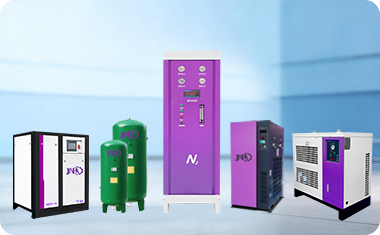
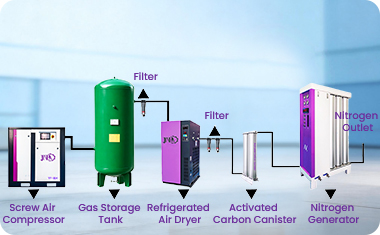
In the industrial nitrogen production system, the nitrogen compressor with
dryer serves as the core supporting equipment of the entire nitrogen making
unit, which is widely used in laser cutting, precision electronics, food and
pharmaceutical manufacturing, chemical spraying and other industries. Different
from ordinary single compressors, the integrated model with a dryer can
synchronously complete air compression, dehumidification and drying, and stable
pressure output. It provides clean and dry air source for nitrogen making
equipment, ensuring nitrogen purity and stable equipment operation. Many
enterprises only focus on the initial procurement price during selection, but
ignore the long-term operating costs, resulting in high energy consumption,
frequent failures and excessive maintenance work in the later stage, which
greatly increases the overall operating expenses. From the perspective of core
operating cost dimensions, this article comprehensively analyzes the hidden
expenses of nitrogen compressors with dryers, including energy consumption,
maintenance, accessory loss and shutdown loss, providing practical references
for enterprises to reduce costs and improve efficiency.
Energy consumption cost is the most critical and long-term operating
expenditure of nitrogen compressors with dryers, accounting for more than 70% of
the full-cycle operating cost. This integrated machine includes multiple
power-consuming modules such as the compression main unit,
refrigerated/adsorption dryer, heat dissipation system and filtration system.
The synchronous operation of dual modules leads to higher energy consumption
than ordinary compressors. Low-end basic models on the market suffer from low
energy efficiency conversion rate, poor heat dissipation and high no-load energy
consumption. The equipment consumes power continuously during operation and
generates invalid energy consumption even in no-load standby state. In contrast,
energy-saving integrated models are equipped with variable frequency speed
regulation systems, which can automatically adjust speed and power according to
air demand, accurately match working conditions and avoid no-load energy waste.
Meanwhile, the drying modules of high-quality models adopt low-energy
dehumidification technology. Compared with ordinary drying equipment, the hourly
power consumption can be reduced by 15%-25%. For factories with 24-hour
continuous operation, the annual power cost difference is extremely significant,
becoming the core factor leading to the gap in long-term operating costs.
Daily maintenance and accessory replacement costs are easily overlooked
hidden expenses that directly determine the service life and operational
stability of the equipment. The nitrogen compressor with dryer features a
complex structure, including various vulnerable accessories such as compressor
filter elements, dryer adsorbents, precision filters and condensate drain
valves. Low-cost low-end models adopt inferior adsorbents, ordinary filter
elements and simple sealing parts to control production costs, resulting in poor
dehumidification effect and fast accessory loss. The filter elements need to be
replaced every 1 to 2 months, and the adsorbents will fail within half a year,
which not only increases accessory procurement costs but also requires more
labor for regular inspection and replacement. In comparison, industrial-grade
high-quality integrated machines adopt high-purity molecular sieve adsorbents
and long-life precision filter elements with excellent wear resistance and aging
resistance. The replacement cycle of filter elements is extended to 6 to 12
months, and the service life of adsorbents can reach 3 to 5 years, which greatly
reduces accessory replacement frequency and labor maintenance costs, delivering
better economy in long-term operation.
Equipment failure and shutdown loss are indirect but highly influential
operating costs. If the matching degree between the compressor and dryer is
insufficient or the drying module fails, the water content of compressed air
will exceed the standard, directly causing substandard nitrogen purity of
downstream nitrogen making equipment, water accumulation and rust in pipelines,
and damage to precision workshop equipment. Low-end integrated machines often
suffer from frequent faults such as incomplete drying, pipeline condensation and
unstable pressure. Frequent shutdowns for maintenance will not only interrupt
production progress and reduce capacity efficiency, but also generate high
equipment maintenance fees. In severe cases, unqualified air sources will lead
to product scrapping and order delays, causing additional economic losses.
High-quality integrated equipment features accurate working condition matching
and stable cooperative operation of drying and compression systems with
extremely low failure rates, enabling long-term continuous trouble-free
operation, avoiding hidden losses caused by shutdowns and ensuring production
continuity.
In addition, operation and maintenance as well as adaptation loss will
slightly increase operating costs. Non-standard low-end equipment has
complicated operation and difficult commissioning, requiring professional
personnel for regular operation and maintenance with higher labor costs.
Meanwhile, substandard drying effect fails to adapt to high-precision production
conditions, resulting in low equipment utilization and indirect resource waste.
In contrast, intelligent integrated machines are equipped with automatic
dehumidification, pressure stabilization and fault early warning functions,
requiring no full-time on-duty personnel and lowering operation and maintenance
thresholds. With stable air source quality and wide adaptability to various
working conditions, the equipment utilization rate is greatly improved.
In conclusion, the operating cost of a nitrogen compressor with dryer is a
comprehensive expense covering energy consumption, maintenance, failure loss and
labor operation and maintenance, rather than a single energy consumption
expenditure. Enterprises should not only pursue low prices and purchase low-end
equipment blindly. Saving initial procurement costs will lead to high long-term
operating costs. Prioritizing energy-saving, high-configured and high-stability
integrated equipment will bring slightly higher initial investment, but it can
continuously reduce energy consumption and maintenance expenditures, avoid
shutdown losses, recover the price difference within 1 to 2 years, and achieve
long-term cost reduction and efficiency improvement, making it the most
cost-effective selection scheme for industrial production.