In many fields such as industrial manufacturing, biomedicine, food
packaging, laser processing and material heat treatment, inert shielding gas is
essential to stabilize processes and reduce oxidation losses of products. The
traditional gas supply mode relying on externally purchased nitrogen cylinders
or liquid nitrogen faces challenges in long-term operation, including
complicated transportation arrangements, regular cylinder inspection, inventory
management pressure and risk of gas supply interruption. On-site gas generation
solutions have gradually become the preferred option for gas source upgrading
for many enterprises because of on-demand production and independent control. A
nitrogen generator system matching working conditions can continuously supply
stable inert gas for production lines.
A nitrogen generator system takes ambient air as raw material. After
compressed air pretreatment and purification, nitrogen and oxygen are separated
via different technologies. The mainstream technologies available on the market
include membrane separation and pressure swing adsorption, while cryogenic air
separation is mainly adopted for scenarios with extremely large gas consumption.
Membrane separation features a simple structure with few moving parts, stable
operation and low maintenance workload, suitable for applications requiring
moderate nitrogen purity and continuous gas supply. Pressure swing adsorption
relies on the selective adsorption of oxygen molecules by carbon molecular
sieves. Two towers alternate between adsorption and desorption cycles to produce
nitrogen of higher purity, which meets strict requirements in electronic
packaging, precision welding, pharmaceutical raw material protection and other
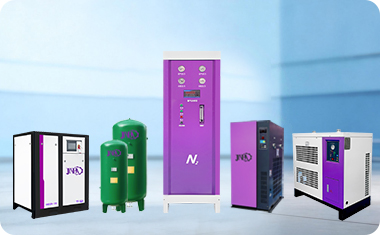
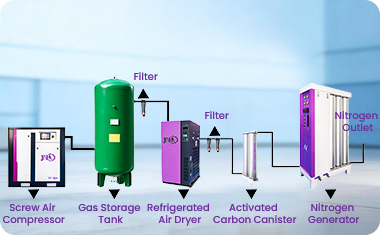
production processes. The whole system generally consists of air compression
unit, filtration and drying assembly, separation main unit, gas storage buffer
tank and monitoring & control module. All units work together to keep stable
output gas parameters.
During equipment selection, users need to conduct comprehensive evaluation
based on actual gas consumption instead of relying on a single parameter. First,
calculate normal flow rate and peak gas demand with proper allowance to avoid
long-term full-load operation which accelerates the aging of internal
consumables. Second, confirm nitrogen purity, dew point and output pressure
required by processes, as standards vary greatly across industries. Requirements
for food preservation are different from those for semiconductor packaging.
Besides, on-site installation space, ambient temperature and humidity, energy
consumption, noise level, as well as special requirements such as oil-free
supply, cleanliness and explosion protection should be considered in scheme
assessment. If qualified clean compressed air is already available on site,
split configurations without built-in air compressors can be selected.
Integrated skid-mounted units are more convenient for workshops with limited
space. Spare part lead time, remote commissioning support and regular inspection
service are also key factors for reliable long-term operation.
With refined development of downstream industries, equipment research
focuses on energy saving, automation and better adaptability. Many developers
optimize internal flow channels to reduce pressure drop and energy consumption.
Online monitoring modules are improved to feed back real-time data such as
purity and pressure, and send alerts for abnormal conditions so that maintenance
staff can respond timely. Apart from standard models, some suppliers can adjust
pipeline connectors, control logic and supporting purification assemblies within
a reasonable scope to fit differentiated on-site conditions of users.
Before project implementation, users are advised to sort out complete
working condition data in advance, including gas consumption fluctuation,
environmental conditions and allowable parameter deviation of processes, and
confirm scheme details with suppliers. After equipment delivery, pipeline leak
detection, parameter commissioning and trial operation shall be carried out in
accordance with technical specifications. A regular maintenance schedule, timely
filter replacement and inspection of valves and adsorption materials can
effectively extend service life and reduce fluctuations of gas quality.
Compared with cylinder supply, the on-site nitrogen generator system
eliminates procedures such as cylinder procurement, transportation, deposit and
annual inspection. Long-term costs are easier to plan, and safety risks caused
by high-pressure cylinder storage are lowered. This solution also has its
application limits. For scenarios with low gas consumption and intermittent use,
it is still necessary to calculate costs and benefits comprehensively before
making a decision.
With continuous industrial development, component interchangeability and
standardized control schemes bring more options for end users. On-site gas
generation can serve as a stable and reliable gas source with proper selection
and standardized maintenance, whether for inert atmosphere protection on small
and medium production lines or continuous gas supply in laboratories. During
supplier evaluation, buyers may focus on test data, reference projects and
full-cycle service support. Priority can be given to partners who can provide
complete test reports, operation manuals and technical documentation, ensuring
the nitrogen generator system runs steadily and continuously for production.