On-site industrial nitrogen production units serve as the foundation for
stable gas supply in many manufacturing lines. During long-term continuous
operation, various consumables, sealing parts and control components wear
gradually with cyclic operations. The selection, procurement planning and
replacement timing of spare parts directly affect operational stability and
long-term maintenance expenditure of the whole unit. Many production facilities
only focus on equipment procurement investment while neglecting continuous
spending brought by spare parts. Without systematic sorting of spare part cost
composition, matching standards and inventory plans, unplanned shutdowns,
mismatched parts and budget overruns may occur easily.
Spare parts for nitrogen production units can be divided into three
categories according to wear characteristics: high-frequency wearing parts,
medium-cycle consumables and long-life core components. High-frequency wearing
parts mainly include precision filter elements, valve sealing diaphragms and
solenoid coils. These components are continuously exposed to compressed air and
eroded by airflow, oil and water impurities, so they wear quickly and should be
included in regular preventive replacement schedules. Medium-cycle consumables
are represented by carbon molecular sieves and drying adsorption fillers, which
are core separation media for adsorption nitrogen generators. They enjoy a
relatively long service life under stable pre-treatment conditions. Once the
front purification system fails, the media will deactivate rapidly and require
early replacement. Long-life components include pressure transmitters, nitrogen
monitoring instruments and pipe fittings. They have low failure rates under
normal conditions and are generally kept as emergency stock.
Spare part costs are determined by multiple factors, and the listed price
alone cannot be used as the only evaluation standard. First comes compatibility.
Original matched components are tested under full operating conditions with
consistent dimensional tolerances, materials and temperature-pressure resistance
indicators, delivering reliable compatibility. Third-party alternatives provide
more choices, yet processing standards and raw material quality vary widely
among suppliers. Technical parameters must be verified before purchase to avoid
gas leakage or purity fluctuation caused by specification mismatch. Second,
material and manufacturing standards create differences. For sealing parts with
identical functions, materials such as fluororubber and nitrile rubber differ
greatly in oil resistance, temperature tolerance and anti-aging performance.
Parts designed for high-purity and high-pressure service adopt stricter
production standards. Purchase volume, lead time, logistics and supporting
technical services also shape total expenditure. Urgent small-batch orders
usually lead to higher comprehensive costs.
Sound spare part management aims to balance inventory reserve and capital
occupation. Enterprises can build graded spare part lists based on equipment
runtime, historical failure records and replacement intervals. A small safety
stock of high-frequency wearing parts ensures smooth scheduled maintenance.
High-value core media with long replacement cycles can be ordered on demand with
agreed delivery schedules to reduce capital tie-up. Meanwhile, maintenance of
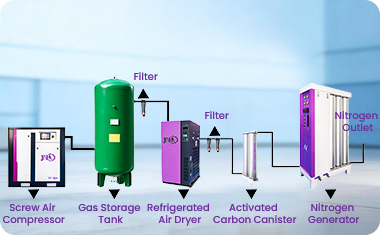
the front air pre-treatment system matters. Oil, moisture and dust in compressed
air are major triggers accelerating spare part aging. Proper operation of
upstream filtration and drying systems can extend service cycles and reduce
replacement frequency.
Standardized procedures are critical during part replacement. Pipe pressure
difference and valve response should be checked when replacing filter elements
and diaphragms. Adsorption media must be evenly packed inside towers to avoid
compaction and uneven flow that cause powdering. After replacement, nitrogen
purity, pressure and flow indicators shall be verified to restore stable
operation. Instrument-type spare parts often require calibration after
installation to guarantee accurate readings and support timely performance
tracking.
From a life-cycle perspective, spare part management is an essential part
of equipment reliability control. Blind pursuit of low-cost parts may trigger
repeated failures and shutdown losses, pushing up overall operating costs. Sole
reliance on original components will inflate maintenance budgets. Operation
teams can set up performance logs to record actual service life and parameter
changes before and after replacement. Accumulated data helps form customized
procurement and maintenance routines matching site conditions. Rational spare
part planning reduces unplanned downtime risk, maintains steady inert gas supply
and helps production sites manage gas-related maintenance expenses
reasonably.