The PSA nitrogen generation process separates oxygen and nitrogen based on
different adsorption rates on carbon molecular sieves. Stable long-term
operation relies heavily on drying and purification in the pretreatment stage.
After compression by air compressors, feed air carries large amounts of
moisture, oil mist and solid particles. Moisture occupies adsorption sites
preferentially, weakening oxygen capture capacity. Continuous moisture ingress
may cause pulverization and failure of molecular sieves and disrupt the
separation cycle. A well-configured psa nitrogen generator with air dryer
integrates the drying unit into the upstream process chain, controlling feed air
quality at the source and laying a solid foundation for subsequent
nitrogen-oxygen separation.
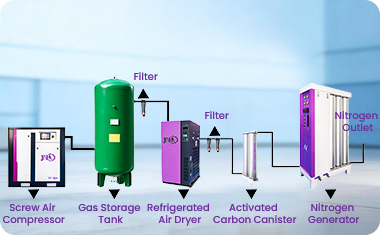
The complete process consists of six stages: air compression, pressure
buffering, drying, multi-stage filtration, PSA separation and nitrogen delivery.
Ambient air is compressed to the set pressure and flows into a buffer tank to
reduce airflow pulsation and stabilize inlet pressure. The gas then enters the
drying unit, which can be refrigerated or desiccant type according to working
conditions, to lower the pressure dew point and condense most water vapor. After
drying, the gas passes through multi-stage precision filters to remove residual
oil droplets and fine dust. Only clean and dry feed air enters adsorption towers
filled with carbon molecular sieve. This upstream treatment design distinguishes
a psa nitrogen generator with air dryer from simplified units without drying
equipment.
The main PSA section adopts a dual-tower alternating cycle controlled by
programmed valves. One tower works under pressure for adsorption, where carbon
molecular sieve captures oxygen molecules and allows nitrogen to flow out for
use. Meanwhile, the other tower undergoes depressurization, purging and pressure
equalization for regeneration to release trapped oxygen and restore adsorption
capacity. The two towers switch continuously to maintain uninterrupted nitrogen
supply. Without an air dryer, humid air continuously enters the towers,
gradually reducing adsorption capacity, causing nitrogen purity fluctuation and
shortening consumable service life. Therefore, for applications such as laser
processing, heat treatment, chemical tank blanketing and electronic packaging
requiring stable nitrogen quality, many projects select a psa nitrogen generator
with air dryer to maintain consistent process results.
The operating status of the air dryer should be monitored as part of the
whole nitrogen system. Refrigerated dryers remove moisture through cooling
cycles, suitable for general scenarios with relatively low maintenance workload.
Desiccant dryers achieve much lower dew points for high-purity and low-dew-point
requirements, yet consume part of the product gas for regeneration. When
selecting a psa nitrogen generator with air dryer, users shall match dryer types
according to local humidity, compressor style and dew point requirements instead
of only referring to gas flow parameters. Oil-injected compressors deliver air
with higher oil content, so oil removal filters are required alongside the dryer
to protect molecular sieves.
Matching process parameters greatly affects system energy efficiency. Inlet
pressure, temperature and dew point change the adsorption load of molecular
sieves. High inlet temperature raises saturated water content and increases
dryer burden; pressure fluctuation disturbs adsorption equilibrium and leads to
nitrogen purity drift. Operators shall record dryer outlet dew point, oxygen
content at nitrogen outlet and valve switching sequence regularly and check
automatic drain traps for blockage. Blocked drains may allow liquid water to
travel downstream and damage the pretreatment chain. Proper inspection and
maintenance extend the service life of adsorption media, filter elements and
seals inside a psa nitrogen generator with air dryer and reduce unplanned
shutdowns.
Compared with simplified nitrogen units without drying modules, a psa
nitrogen generator with air dryer requires higher upfront investment, yet
delivers stable gas quality and better consumable protection over time.
Simplified systems tend to suffer purity drop in humid seasons or damp
environments, and frequent molecular sieve replacement increases long-term
operating cost. During evaluation, buyers should not compare only main unit
prices. Total cost of ownership shall be estimated based on site conditions,
annual running hours and process standards. Dryer configuration brings more
obvious value for workshops in humid regions and outdoor gas stations.
Process expandability can be considered in the early design phase. Some
production lines plan to raise gas flow or purity later. When planning a psa
nitrogen generator with air dryer, expansion interfaces can be reserved.
Additional adsorption towers or upgraded dryer modules can be added later
without full system replacement, adapting to growing production capacity.
Integrated skid-mounted versions feature shorter pipelines and lower leakage
risk after installation, suitable for compact workshops. Split layout
facilitates separate maintenance and suits large-flow gas stations running
continuously.
Nitrogen quality directly influences finished product yield. Stable dew
point and purity help reduce welding porosity, cut surface oxidation and
material deterioration. Nitrogen generation is an interconnected process system.
Drying pretreatment is not an optional accessory, but a necessary barrier to
keep PSA separation working reliably. Proper configuration of a psa nitrogen
generator with air dryer and linked monitoring between dryer and nitrogen host
keeps feed air indicators within design ranges. In this way, qualified nitrogen
can be supplied steadily to support smooth downstream operations.