In continuous industrial production lines, processes such as laser cutting,
chemical reaction shielding, pharmaceutical intermediate manufacturing and
powder metallurgy sintering put forward high requirements for uninterrupted
inert gas supply. Gas supply interruption may lead to material oxidation,
workpiece rejection or even shutdown of the whole production line. Limited by
delivery schedules and residual gas capacity, traditional cylinder gas supply is
difficult to match the rhythm of non-stop production. Nitrogen generation
equipment based on carbon molecular sieve adsorption, with the working mechanism
of dual-tower alternate circulation, has become a gas source solution for many
continuous production scenarios.
This type of equipment uses carbon molecular sieve as the core adsorption
medium and separates nitrogen and oxygen by pressure swing adsorption principle.
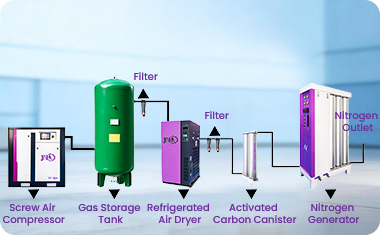
Clean air after compression, multi-stage filtration and drying pretreatment
enters the adsorption tower. Under pressurized conditions, carbon molecular
sieve preferentially captures oxygen molecules in the air, while nitrogen passes
through the adsorption bed for output. At the same time, the other tower
performs pressure relief and desorption to release adsorbed oxygen and realize
molecular sieve regeneration. Controlled by a program control system, the two
adsorption towers keep switching working states to achieve uninterrupted gas
production. This operating logic lays the foundation for the equipment to adapt
to long-duration working conditions. A complete set of equipment generally
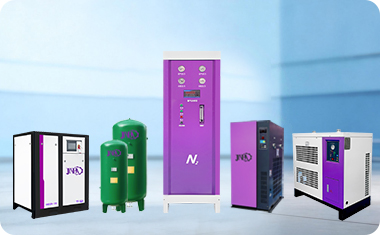
includes an air pretreatment unit, adsorption tower assembly, program-controlled
valve group, gas storage buffer tank and online monitoring module. The buffer
tank smooths airflow fluctuation and stabilizes output pressure and purity.
Pretreatment design is critical to stable long-term operation. Oil,
moisture and dust impurities in compressed air continuously erode carbon
molecular sieves. Accumulated contaminants degrade adsorption performance and
affect gas output indicators. For this reason, pre-filtration, refrigerated or
adsorption dryers shall be configured properly to control inlet air dew point
and oil content within a reasonable range. Many designs adopt multi-stage
filtration to intercept impurities of different particle sizes step by step,
reduce solid particles entering the tower, slow down molecular sieve
pulverization and extend the service life of adsorbents. Program-controlled
valves are key components for cycle switching. The response speed and sealing
performance of valves directly affect pressure equalization. High-quality valve
assemblies reduce gas loss and energy consumption.
During equipment selection, users shall calculate gas parameters
comprehensively according to on-site working conditions. Besides average flow
rate, attention should be paid to peak gas consumption, allowable purity
fluctuation and output pressure requirements. Indicators vary greatly across
industries. Requirements for regular anti-oxidation protection differ from those
for semiconductor component packaging and precision chromatographic analysis.
Workshop ambient temperature, installation space, power supply conditions, and
special specifications such as oil-free supply and explosion protection should
also be assessed. If zero gas interruption is required for production lines,
backup units or small liquid nitrogen tanks can be equipped as emergency gas
sources together with the main unit to build multi-layer gas supply protection.
Maintenance support also matters. Lead time for consumables including filter
elements, valves and molecular sieves, and response capacity of remote
commissioning and on-site inspection will influence long-term usage.
As downstream industries become more automated, monitoring functions of
such equipment keep improving. Many models are equipped with PLC control systems
together with sensors for purity, pressure and flow rate to collect operating
data in real time. Alarms will be triggered once parameters deviate from preset
ranges so that maintenance staff can troubleshoot risks in advance. Some systems
support data logging and remote access, helping factories build operation
records and track working condition changes. Apart from standard models,
suppliers can adjust pipeline layout, timing parameters and purification
configurations within a reasonable scope to fit customized site layout and gas
demands.
After commissioning, regular maintenance is essential for stable gas
production. Replace filter elements on schedule according to operation manuals,
inspect valve sealing and pipeline leakage periodically, and log daily operating
parameters. After long service time, the adsorption efficiency of molecular
sieves declines gradually. Adsorbent materials can be refilled or replaced based
on actual gas production test results. Standardized maintenance sustains stable
gas output, lowers failure risks and reduces unplanned shutdowns.
Compared with gas cylinders and outsourced liquid nitrogen, on-site
nitrogen generation avoids cylinder transportation, deposit and periodic
inspection. Gas supply is self-controlled and long-term operating costs are
easier to estimate. This solution also has its applicable scope. For scenarios
with low gas consumption and intermittent usage, cost and benefit should be
calculated comprehensively before confirming the gas supply mode. For continuous
industrial production, carbon molecular sieve nitrogen generators can deliver
nitrogen steadily with proper selection and standardized maintenance, providing
inert shielding for production lines. During supplier evaluation, buyers may
focus on measured equipment performance data, application references under
similar working conditions and full-cycle service packages. Partners who can
provide complete test documents and operation guides are preferred to ensure the
gas source system matches long-term non-stop production requirements.