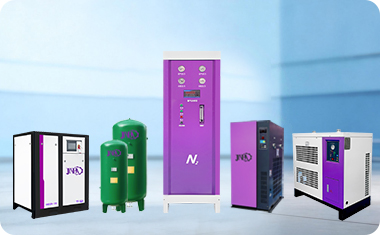
Nitrogen generation equipment continuously supplies inert protective gas
for industrial production. Its structural form directly affects operating
stability, cleanliness level and maintenance convenience. Fully enclosed
nitrogen generators adopt an integrated sealed structure, combining gas source
pretreatment, adsorption separation, gas storage buffering and control
components within one unit to reduce external interference. This represents a
solution worth attention in gas supply system planning.
From the structural perspective, the primary advantage of the fully
enclosed design is reducing the influence of the external environment on
internal processes. In conventional layouts, functional units are installed
separately with numerous pipeline connections, making them vulnerable to
interference from ambient temperature, humidity and dust. An integrated sealed
structure consolidates these links, making internal processes relatively
independent. The impact of environmental factors on adsorption and gas supply is
thereby reduced, helping to maintain stable gas output quality.
Cleanliness control is also a key consideration of fully enclosed units.
For industries with strict gas cleanliness requirements such as food,
pharmaceutical and electronics, secondary contamination of feed gas during
transmission is a critical issue to avoid. The integrated sealed structure
reduces the chance of gas contacting the external environment. Combined with
internal filtration and purification units, it effectively controls impurity
carryover and reduces the burden on downstream processes. The more compact the
structure, the more important the reliability of sealing points. The material
selection and assembly quality of seals directly affect long-term
performance.
From the perspective of operation and maintenance, fully enclosed units are
usually equipped with centralized monitoring and control systems. Operating
status and key parameters can be displayed on a unified interface, so managers
do not need to check scattered components one by one, improving management
efficiency. Internal units are organized in a modular manner, and standardized
maintenance procedures shorten inspection time and reduce the impact of
downtime. It should be noted that although the sealed structure reduces external
interference, certain requirements are placed on heat dissipation. The unit
generates heat during operation, so reasonable ventilation and cooling design
must be ensured to avoid affecting component status due to excessive local
temperature.
During selection and application planning, fully enclosed units need
comprehensive evaluation based on actual working conditions. The first factor is
space conditions. The integrated structure occupies relatively compact space,
suitable for places with limited area or clean layout requirements. The second
factor is gas consumption characteristics. Output, purity requirements and
supply continuity directly determine the configuration plan. Enterprises should
sort out their actual gas requirements, clarify core parameters such as flow
rate and purity, and then evaluate structural suitability based on site
conditions.
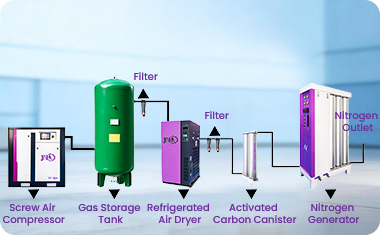
Supporting equipment also cannot be ignored. Fully enclosed nitrogen
generators still need stable gas source supply as support. The pressure, flow
rate and cleanliness of air supply equipment must match the design parameters of
the unit. If front-end supply conditions are unstable, internal processing units
bear extra load, affecting gas output quality and component life. Therefore,
overall planning of the gas supply system should remain consistent to ensure
coordinated parameters at all stages.
Routine maintenance is the foundation for long-term stable operation. Even
with a well-designed structure, adsorption media, filter elements and sealing
parts still have service cycles and require regular inspection and replacement
according to specifications. Managers should pay attention to trends in outlet
parameters. Once anomalies appear, they should promptly check gas source,
pipelines and sealing points to prevent problems from accumulating and affecting
gas supply. Meanwhile, complete operating records support later analysis and
optimization, providing references for equipment maintenance.
From the development trend perspective, the fully enclosed design is often
combined with automatic control to form highly integrated gas supply units.
Centralized monitoring, parameter adjustment and anomaly prompts make equipment
operation management more efficient. However, configuration choices should
return to actual demand. Enterprises should not simply pursue structural form,
but comprehensively consider gas production performance, operating cost,
maintenance conditions and their own management capabilities to select a plan
suitable for their processes.
Overall, fully enclosed nitrogen generators offer certain advantages in
reducing environmental interference, improving cleanliness control and
optimizing management efficiency through integrated sealed structural design.
Rational planning and maintenance are the premises for realizing these
advantages. Enterprises should evaluate the applicability of the equipment
rationally based on process requirements, site conditions and long-term gas
demand, and make proper supporting and maintenance arrangements, so as to obtain
stable and reliable gas supply support for continuous production.