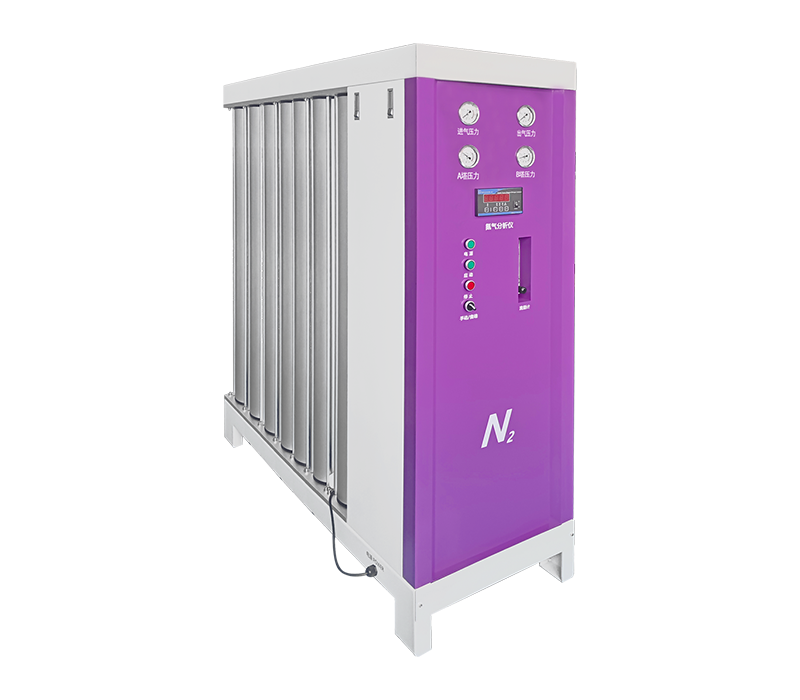
The selection of nitrogen supply mode is a key factor affecting the operational efficiency, safety and cost of laboratory experiments. Traditional high-pressure nitrogen cylinders and modern laboratory nitrogen generators are the two mainstream nitrogen supply schemes in laboratories, and there are significant differences in safety, economy, stability and convenience between the two modes. For a long time, nitrogen cylinders have been widely used in small and medium-sized laboratories due to their simple access mode, but with the improvement of laboratory precision requirements and safety management standards, the inherent defects of cylinder gas supply are gradually prominent, while laboratory nitrogen generators show comprehensive advantages and have become the mainstream replacement scheme for laboratory gas supply.
In terms of safety performance, laboratory nitrogen generators are far superior to nitrogen cylinders. Nitrogen cylinders belong to high-pressure pressure-bearing equipment, with internal pressure up to 15MPa or more. There are serious safety hazards such as cylinder leakage, explosion, and overturn impact during transportation, storage and use. In addition, nitrogen cylinders require regular special inspection by professional institutions, and unqualified cylinders are prone to gas leakage and pressure failure, which brings great safety risks to laboratory personnel and equipment. In contrast, laboratory nitrogen generators work under normal pressure and low pressure, with no high-pressure gas storage link. The whole machine is equipped with multiple safety protection mechanisms such as overpressure relief, overload protection and fault alarm, which fundamentally eliminates high-pressure safety hazards. The on-site gas production mode avoids the risks of cylinder transportation and storage, and greatly improves the overall safety level of the laboratory.
In terms of gas supply stability and experimental applicability, nitrogen generators have obvious advantages. The gas pressure and purity of nitrogen cylinders will gradually decay with the consumption of gas volume. In the later stage of cylinder use, unstable pressure and declining purity will cause interference to precision instrument detection, resulting in experimental data deviation and poor repeatability. Moreover, the cylinder gas supply is discontinuous, and the replacement of empty cylinders will lead to experimental interruption, affecting the progress of continuous detection experiments. Laboratory nitrogen generators can realize 24-hour continuous on-demand gas production, with stable output pressure and constant gas purity throughout the operation process, which can perfectly adapt to the long-term continuous working state of precision instruments such as GC, LC-MS and NMR, and ensure the accuracy and consistency of experimental data.
From the perspective of economic cost and operational convenience, nitrogen generators have long-term cost advantages. The use of nitrogen cylinders requires repeated purchase of gas sources, and additional costs such as cylinder rental, transportation, and annual inspection are incurred every year. The cumulative annual cost of long-term use is high, and the frequent replacement of cylinders consumes a lot of human resources. Laboratory nitrogen generators only need one-time equipment investment, with only electric energy and a small amount of filter consumables cost in the later stage. The annual operating cost is far lower than the cylinder gas supply mode. In terms of operation, the generator realizes plug-and-play automatic operation without manual cylinder handling and replacement, which greatly saves labor costs. Although the initial investment of nitrogen generators is higher than that of cylinders, the cost can be recovered in 1-2 years of long-term use, and it can bring stable and safe gas supply guarantee for the laboratory for a long time, which is more in line with the standardized and efficient development trend of modern laboratories.










